

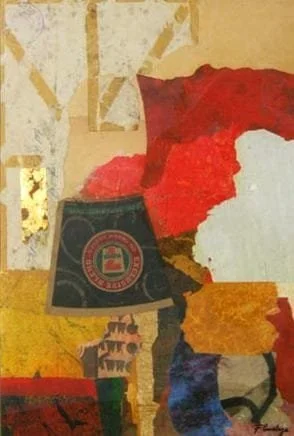
Untitled 3
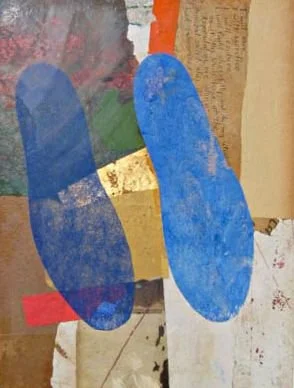
Untitled 4
Fernando Pomalaza
Peruvian
Peruvian-born, New York City based artist (who for many years showed at the Marunouchi Gallery in SoHo) presents to the viewer a complex interplay of textures and forms. His canvas, “Escaping the Pandemic,” showcases a deliberate application of bulbous, lugubrious black paint, evoking mandala-like wheels of incarnation. The accentuated suggestion of the repoussé technique, characterized by wrought iron circles of muscular, black, bulging steel, gives rise to sculptural forms that seem to emerge from cauldron-like founts of molten metal. These forms appear to be suspended in limbo, caught between states of afterlife dispensation.
Pomalaza’s architectural overlay constructs a grand visage, inviting the viewer to ponder the mystery that lies beyond. The abstract apparition which emerges behind these gates poses a question: how will one journey there? This enigmatic quality is reminiscent of the surrealist tradition, particularly in the works of Max Ernst, which explore biomorphic forms and alchemical transformations.
In other works, Pomalaza’s black, stacked, liquid architectures exhibit a calligraphic quality, with zigzag outlines that recall the expressive brushstrokes of Franz Kline. However, Pomalaza’s forms are more contained than the Hercules of Ab-Ex’s, and in part evoke the structural rigor of Piet Mondrian’s geometric abstractions. The black lines in Pomalaza’s works indeed bear a correlative relationship to Mondrian’s use of grid-based compositions. Though more svelte than Kline’s strokes, swipes, and slashes, in comparison to Mondrian’s square and rectangle visual dances, Pomalaza’s forms are more fluid and dynamic. Further, the parameters of Pomalaza’s lines do not hold the colored shapes like straight-jackets, but rather allow them to recede into a different but subsequent episode of pictorial construction to that of the Dutch Émigré who fell in love with DeWitt Clinton’s Manhattan matrix above Houston Street.
For this writer it was while attending famed Judson Church-associated choreographer Trajal Harrell performance, “Monkey Off my Back or Cat’s Meow,” a hybrid dance work staged at the Park Avenue Armory with a Mondrian inspired catwalk dance floor, where going through his mind was the eternal missive “what am I missing here ?” that he realized that Pomalaza’s black paint-driven works are among other things inherently variations upon Mondrian.

The paint outlay in some of Pomalaza’s works is structured like the interior architectural framework of a Southwestern U.S. Native American cliff dwelling, branded to the canvas, and at times his silhouettes recall the works of Kara Walker, done in a pastiche or quasi-pastiche of social commentary. The circling repoussé-like element in the work once again echoes the work of Franz Kline and also Robert Motherwell, and Richard Poussette Dart in contemporary painting’s lexicon, though Pomalaza’s lines, shapes, and connections are more rhomboid and balustrade-like.
Pomalaza’s innovative use of black paint situates him within a long lineage of artists who have reinvented the use of this color. From the masters of chiaroscuro, such as Goya, and Rembrandt to the modernists like Manet, Rauschenberg, Reinhardt, Stella, and Rothko, the use of black has been a powerful tool for artistic expression.
Lee Klein